


The meaning of SNT is Special Needs Trust—a legal financial arrangement that holds assets for a person with a disability without counting those assets against eligibility for government benefits like Medicaid and SSI. It safeguards the resources you put aside while maintaining the advantages your child depends on.
If you're a special needs parent Googling this term at midnight, you've come to the right place. You’re likely trying to protect your child’s future without making a costly mistake.
This guide explains what an SNT means, how it works, and when families use it, including key types, funding options, and the trustee’s role. The goal is to keep things clear.
For more information like this, subscribe to the newsletter and join over 2,000 parents receiving practical guidance on insurance planning, special needs trusts, daily living strategies, and helpful resources delivered to your inbox every week.

Key Takeaway:
- A supplemental needs trust protects assets while preserving eligibility for SSI and Medicaid.
- Even small gifts or inheritances can trigger the “asset cliff” and put benefits at risk without proper planning.
- First-party, third-party, and pooled trusts each serve different situations based on funding source and family needs.
- An SNT can cover quality-of-life expenses but not basic needs like food or housing.
- ABLE accounts and SNTs can work together, with each serving different spending purposes.
- Choosing the right trustee is critical to ensure funds are managed properly over time.
- Planning early helps secure lifelong financial support for autistic individuals beyond a parent’s lifetime.
For more information on how to customize funds to your special family's unique needs, look into special needs financial planning services.
Table of contents:
- What is the Meaning of SNT?
- How The Autism Voyage Helps Special Needs Families
What is the Meaning of SNT?
If you're wondering what SNT stands for, it means "Special Needs Trust," also known as a "Supplemental Needs Trust." In legal terms, it's a trust that holds assets for an individual with a disability without affecting their eligibility for Medicaid or SSI.
To put it simply, it allows you to save money without jeopardizing your child's benefits. The distinction between "special needs" and "supplemental needs" is that the former emphasizes the individual, while the latter emphasizes that money is intended to supplement rather than replace benefits.
To better understand how this fits into real-life planning, explore how families navigate financial planning for special needs dependents.

Why an SNT Matters Specifically for Autistic Individuals
A special needs trust for autistic child is critical because of the “asset cliff,” where even a small gift or inheritance can push assets over strict limits and wipe out SSI or Medicaid overnight. For instance, even though the intention was to assist, an adult with autism who receives $2,000 from a kind relative may lose benefits almost instantly.
Numerous families have experienced similar situations where a straightforward act of assistance resulted in unanticipated stress and disturbance. Careful planning is crucial because the majority of autistic people require financial support for the rest of their lives, long after their parents have passed away.
Here are the key benefits it helps preserve:
- Medicaid
- SSI (Supplemental Security Income)
- Section 8 housing assistance
- State waiver programs
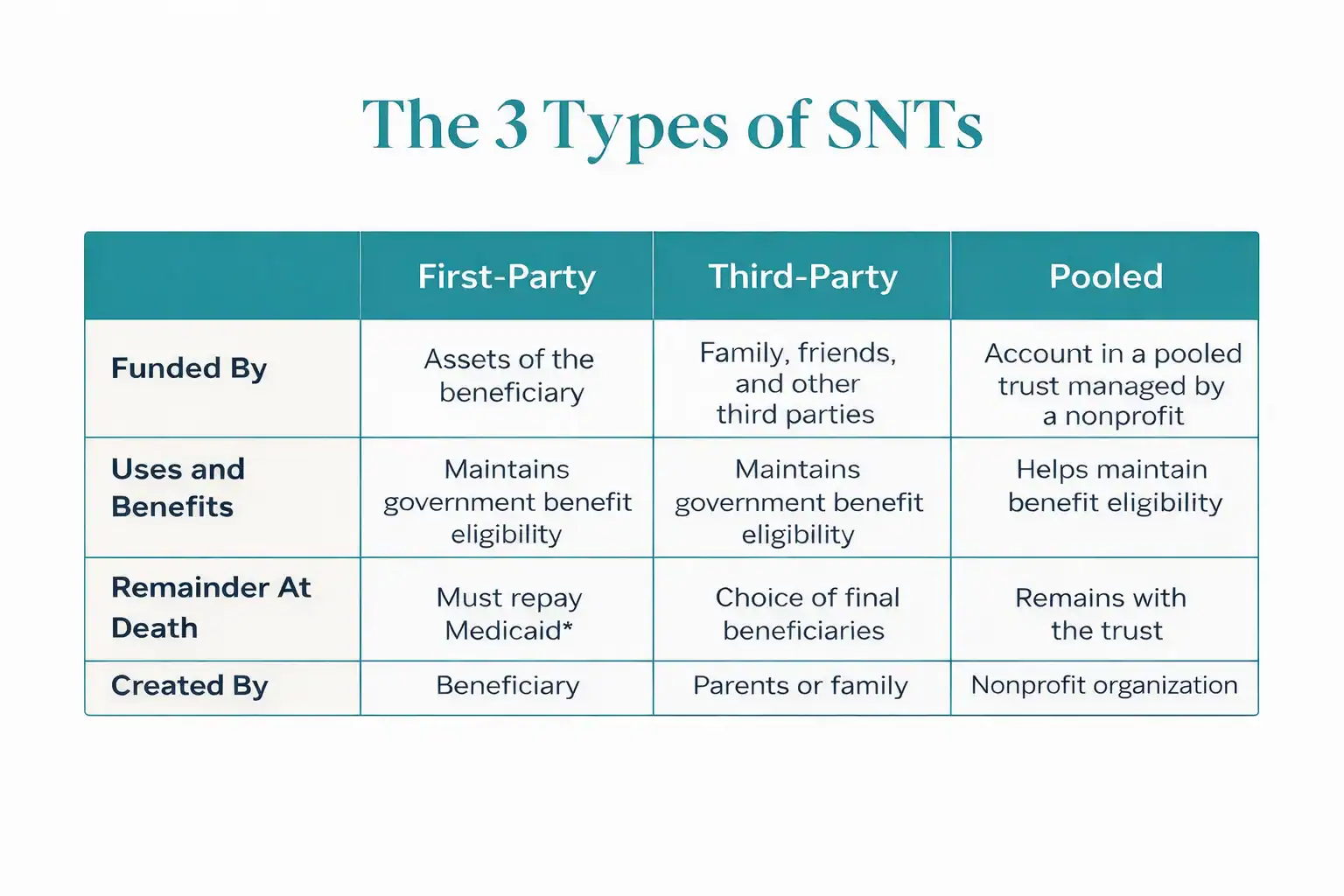
The 3 Types of SNTs: First-Party, Third-Party & Pooled
Knowing the differences between first-party and third-party SNT and pooled trusts will help you decide what is best for your child. A first-party trust must be established prior to the age of 65 and is used for money such as settlements.
Parents use a third-party special needs trust, which has no age restrictions, for long-term planning. A pooled special needs trust can be used at any age and is useful for smaller sums of money or when a managed option is required.
Each type fits a different situation. First-party trusts are often used after unexpected events like settlements, while third-party trusts are created proactively to protect future inheritance.
Pooled trusts offer a simpler, managed option for families who need structure without full trustee responsibility. Choosing the right type early helps avoid benefit disruption and keeps support stable.
Check the table below:
To explore each option further, review the different types of special needs trusts
What Can an SNT Pay For? (And What It Can't)
The key to understanding special needs trust, SSI, and Medicaid is that while an SNT can enhance quality of life, it cannot take the place of basic support. Many families are caught off guard because an SNT is intended to supplement benefits rather than interfere with them.
An ABLE account established under the 2014 ABLE Act might be a better choice for regular expenses like housing or food because it permits more flexible spending without the same limitations.
Can pay for:
- therapy not covered by Medicaid (including ABA top-ups)
- special equipment (AAC devices, sensory equipment, assistive technology)
- education and social programs
- transportation
- dental
- recreation and hobbies
- vacations
- service animals
- camps
Cannot pay for:
- food
- shelter
- direct cash distributions
To better understand the details, explore what can special needs trust funds be used for and review the special needs trust spending rules.
Who's Who in an SNT: Grantor, Trustee & Beneficiary Explained
Understanding roles in a trust helps you avoid confusion later. Here’s a simple breakdown to guide you:
- Grantor: the person who creates and funds the trust, usually a parent
- Beneficiary: your autistic child or family member who receives the support
- Trustee: the person responsible for managing and distributing funds based on the trust rules (trustee responsibilities are ongoing and critical)
- Choosing a trustee: can be a family member, a professional trustee, or a pooled nonprofit depending on complexity and trust needs
- Successor trustee: steps in if the original trustee can no longer serve
- Remainder beneficiaries: receive any remaining funds, with Medicaid payback rules applying in certain trusts.
Explore special needs trust beneficiary rights to better understand your rights in this structure.
How to Set Up an SNT: A Step-by-Step Overview for Autism Families
Setting up an SNT can feel overwhelming, especially while managing daily care. Breaking it into steps makes the process more manageable and less intimidating. The goal is to build a plan that grows with your child’s needs, not to get everything perfect at once.
Step 1: Start with financial planning by estimating lifetime care costs for your autistic family member.
Step 2: Find a special needs attorney and vet their experience (directories like the Special Needs Alliance can help).
Step 3: Choose your trustee carefully, as this role manages the trust long term.
Step 4: Draft the trust document with proper legal structure.
Step 5: Fund the trust using cash, life insurance, investments, or real estate.
Step 6: Notify gift-givers so relatives name the trust, not your child, in wills or gifts.
Step 7: Review and update the plan regularly to keep it aligned with your child’s needs.
You don’t need to be wealthy to start, as many families use life insurance as the most practical way to fund an SNT, your family can start by learning how to set up a special needs trust.
SNT vs. ABLE Account vs. Guardianship: Which Does Your Family Need?
An autistic adult can have both an SNT and an ABLE account, and they are often used together. An SNT supports long-term needs without affecting benefits, while an ABLE account covers everyday expenses with easier access.
A direct inheritance without an SNT can push assets over limits and put SSI and Medicaid at risk, which is why proper planning matters.
Here’s a quick comparison of SNT vs ABLE account to help you understand the key differences:
| Feature | SNT (Special Needs Trust) | ABLE Account |
|---|---|---|
| Contribution Limits | No strict limit | Annual limits apply |
| Control | Managed by a trustee | Managed by the individual (or authorized person) |
| Tax Treatment | No special tax-free growth | Tax-free growth if used for qualified expenses |
| Impact on Benefits | Does not affect SSI/Medicaid if structured properly | Limited balance allowed before benefits may be affected |
| Use of Funds | Broader use for supplemental needs | Must be used for qualified disability expenses |
Guardianship handles decision-making, a representative payee manages SSI income, and an SNT protects long-term assets, making each tool serve a different purpose depending on your child’s needs.
Explore special needs estate planning to see how this fits into a bigger plan.

How The Autism Voyage Helps Special Needs Families
Families often feel overwhelmed trying to plan both daily care and long-term security. The Autism Voyage focuses on simple, practical steps that parents can actually follow. It helps you understand how to protect your child without risking benefits or stability. The goal is to give you clarity and confidence as you plan ahead.
Here’s how it supports your family:
- Insurance Planning for Families Raising Neurodivergent Children
- Income Protection Strategy
- Funding Your Special Needs Trust
- Long-Term Care (LTC) Strategy
If you’re ready to move forward, and need help with your financial journey, schedule a call with Michael today!
The Autism Voyage blog is committed to sharing valuable information with our readers as well as practical insights and resources that can help families prepare for success, especially those with special needs.

Disclaimer: All content on TheAutismVoyage.com is for informational purposes only and is not a substitute for medical, legal, financial, or clinical advice. Please consult licensed professionals as needed.
